Storage chosen by the table's name
Extending the SQL syntax would have been cleaner. Encoding the choice in a name prefix let the evaluator run identical statements against all three tables with no special cases.
In-memory database with specialised data structures optimised for specific query patterns, featuring custom implementations of TreeMap, LFU cache, and chunked storage
Team, 20243
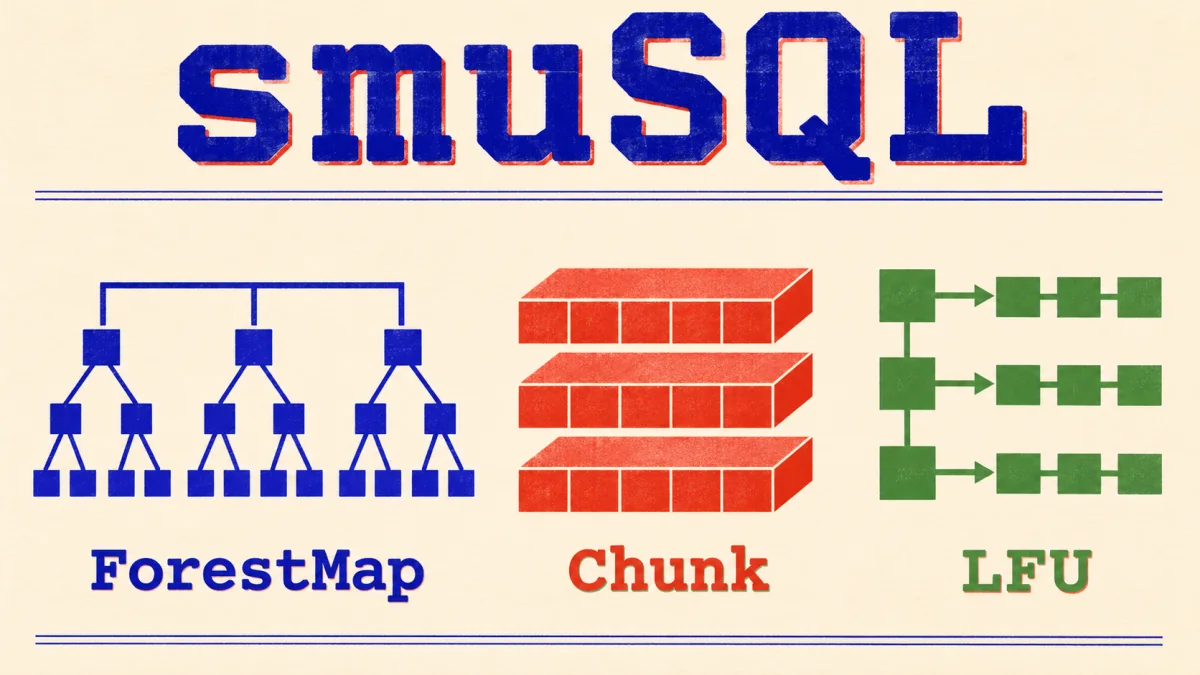
A project for a data structures and algorithms module. Databases rely on general-purpose storage structures; this asks what happens when you swap in one tuned for a single kind of query.
It is a console program that understands a small subset of SQL. The table's name picks its storage: three implementations sit behind one interface, so the very same statements can be run against all three and compared.
A SQL statement enters through the console.
Extending the SQL syntax would have been cleaner. Encoding the choice in a name prefix let the evaluator run identical statements against all three tables with no special cases.
Deleting a row is clearing one bit, and nothing moves until a third of a block is dead. That keeps deletes cheap and scans dense, at the price of occasional tidying.
Uniform random keys flatter every structure equally. I wrote a generator that draws keys so a few are far more popular than the rest, which is the pattern the cache was built for.
Our two benchmark runs disagreed about the forest table: one ranked it fastest, the other slowest at every size. There was no warm-up phase, so I would not quote either as a result. Next time I would fix that before anything else.
A team of five. I wrote the chunk table, the shared table interface, the data types and the skewed-key generator, and started the engine and the evaluator. About half of the 71 commits are mine.