All projects

LearnSDLC

I led the team building LearnSDLC for SMU. Students take one app from requirements to maintenance. I built the microVM runner that executes and grades their code, and the approval step for AI edits.

Team lead, 2026

LearnSDLC pitch

Where grading time went

One testing run spent 34 seconds shutting down microVMs one at a time. I parallelised cleanup and capped concurrent runs at eight to leave room for live previews.

p95 testing review time · preview benchmark
Before
66.5 s
After
32.2 s

6

phases, each with its own room and its own gate

8

copies of the app with one planted bug, which the learner's tests must catch

356

evaluation cases run twice across 11 AI models

15

CI jobs, one of which runs the demo on a clean machine

Why

LearnSDLC teaches the software development life cycle by making you do it. A learner takes one small project, a task tracker, through requirements, design, implementation, testing, deployment and maintenance, and each phase is checked before the next one opens.

It is for people who can already code. A mentor sits beside the work: it reviews, explains and asks questions, and it refuses to write your answer. Teachers get a console for their classes and can upload projects of their own.

A product of the SMU School of Computing and Information Systems, built by team SMUTors.
How it works

Pressing Submit saves a snapshot of the learner’s workspace. The API puts its ID on a Redis-backed BullMQ queue. A worker loads that exact version and sends it to an isolated runner. In the testing phase, the runner tries the learner’s suite against eight versions of the app, each with a different bug. A test that fails on a broken version has caught the bug.

Once the worker saves the grade, a Socket.IO event tells the learner’s open tabs to fetch it. Redis carries the event between API replicas, so the worker can finish on one server while the browser is connected to another. If the browser misses the event, it can still read the saved result over HTTP.

From Submit to a live grade

The API saves a snapshot of the submission.

HTTPjob statuslive updateid onlytests, mutantsevery criterionWeb appNext.js, Monaco editorEvent gatewaySocket.IO, Redis pub/subAPINestJS, 187 routesJob queueBullMQ on RedisGrading workerReloads from the databaseCode runnerPython, isolated executionDatabasePostgreSQL, or SQLite on a laptopMentor and reviewerGuardrails around one modelAI modelOpenAI-compatible

Architecture diagrams

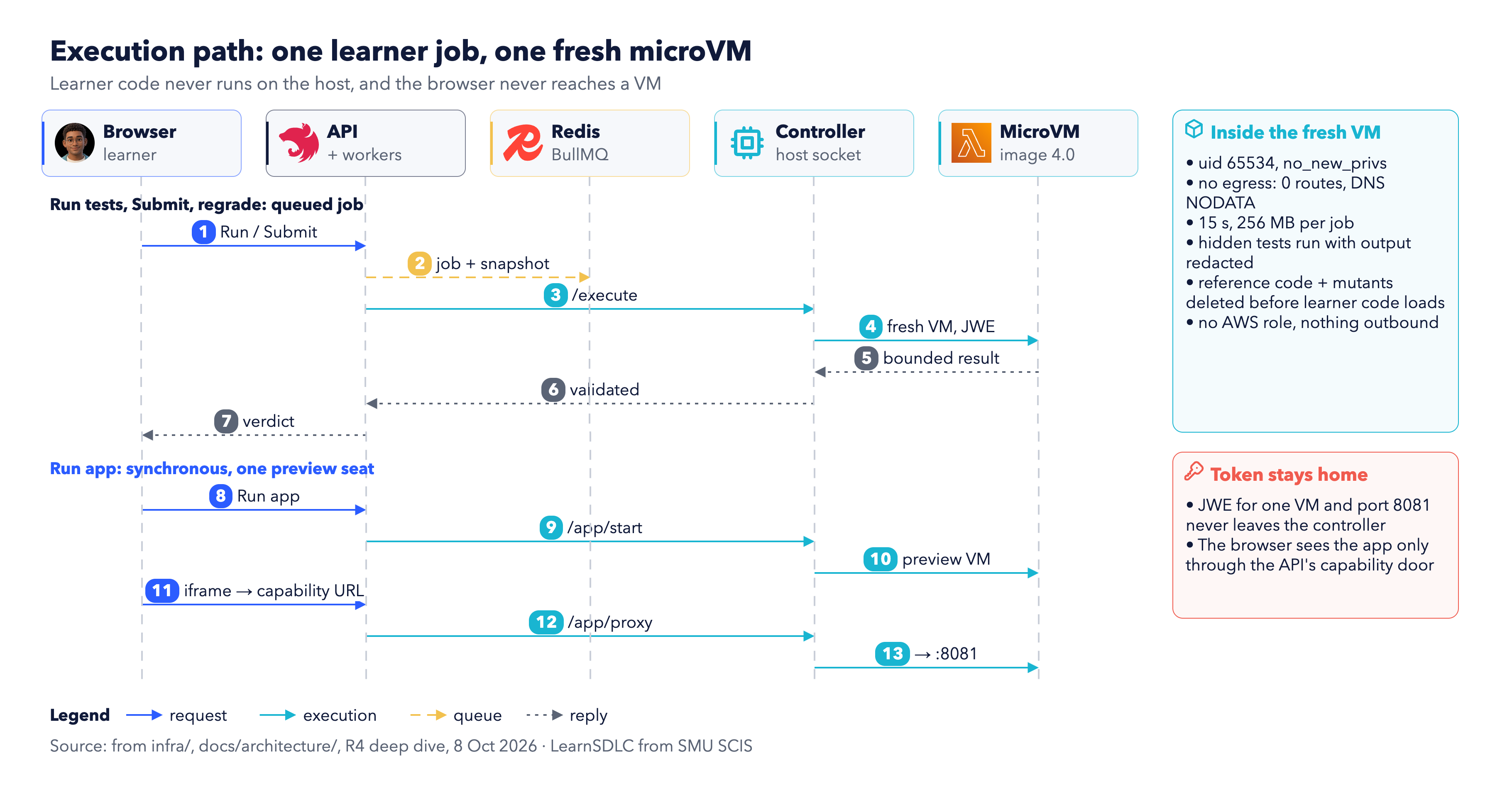
MicroVM execution
Open full size

A grading job gets a fresh microVM and returns a verdict. A live preview keeps its microVM running while the learner uses the app through the API.

Architecture design deck · October 2026

Performance

Parallel microVM cleanup
A trace of 24 submissions showed where learners waited. In a 58.6-second testing pipeline, about 34 seconds went to shutting down microVMs one at a time. I let the controller clean up several at once and capped execution at eight concurrent runs to leave memory for live previews. On the preview deployment, p95 testing review time fell from 66.5 to 32.2 seconds, with seven reviews measured after the change. In a separate replay, all 184 grading verdicts stayed the same.
Smaller AI code edits
I changed code proposals so the model returned only the edits it wanted to make. In a benchmark using 33 recorded proposals and 36 explanation checks, the edit format used about 62% fewer output tokens than whole-file rewrites. On the preview, median wait for a delivered proposal fell from 11.0 to 8.2 seconds. Long design and maintenance edits still pushed p95 to 33.7 seconds, above our 25-second target.
Grading under class load
The single-host load test exposed two bottlenecks. Model calls queued as learners arrived, then three grading workers filled all 24 runner slots. We raised the concurrency limits for model calls and grading jobs and moved to ECS Fargate, RDS and ElastiCache. With the same workload of 100 concurrent scripted learners, p95 review time fell from 318.9 to 31.7 seconds. All 100 learners finished the journey on the managed deployment, up from 65 on the single host.

Decisions

A fresh machine for each grading job

The reference AWS deployment starts each grading job in a fresh microVM and gives each live app preview its own microVM. Both use the same runner interface as the Compose deployment, where Linux Landlock and resource limits isolate learner code.

Hidden tests never touch the workspace

Writing the hidden suite into the workspace would let a job list the temp folder and read it, along with other learners' runs. Graded files are written outside it, imported by the harness, and deleted before a line of learner code loads.

A mentor that is checked three ways

A system prompt alone does not stop a model giving the answer away. A rule refuses solution requests before any model call, a second call reviews each draft, and replies that reproduce the solution are withheld. The price is an extra call and no streaming.

AI edits only after you explain them

In agentic mode the AI proposes a change, the learner explains it, and the explanation is assessed. Approval is tied to that exact proposal and that exact workspace, so editing either one clears it.

Grading fails closed

A pass needs every required check green, a non-empty suite that fully passes, and an AI review that answered and covered every criterion exactly once. With no AI key configured, nothing but a quiz can pass.

Recovering a grade after a worker dies

Pressing Submit twice returns the same in-flight submission. If BullMQ reassigns a stalled job, a conditional database write prevents the old worker from overwriting the newer result. CI kills a worker mid-grade and checks that the submission still finishes.

My part

I led team SMUTors and worked on the backend and AI. I built the versioned project model, the MicroVM execution path for learner code and the approval step for AI edits. A learner explains a proposed change before applying it. Editing the proposal or changing the workspace invalidates that approval.

I compared 11 models on 356 cases from the product and built the tools to reproduce the scores. When we repeated the evaluation with the same inputs, 17% of the outcomes changed. Mentor feedback varied the most.

Built with

Jobs & events
  • BullMQ
  • Redis Pub/Sub
  • Socket.IO
Code execution
  • Python
  • Linux Landlock
  • AWS Lambda
Backend
  • TypeScript
  • NestJS
  • TypeORM
Frontend
  • Next.js
  • React
  • Monaco Editor
  • Tailwind CSS
Storage
  • PostgreSQL
  • SQLite
  • Redis
Deployment
  • Docker Compose
  • Caddy
  • Terraform
Testing
  • Jest
  • Vitest
  • Playwright
  • pytest