All projects

It Dropped

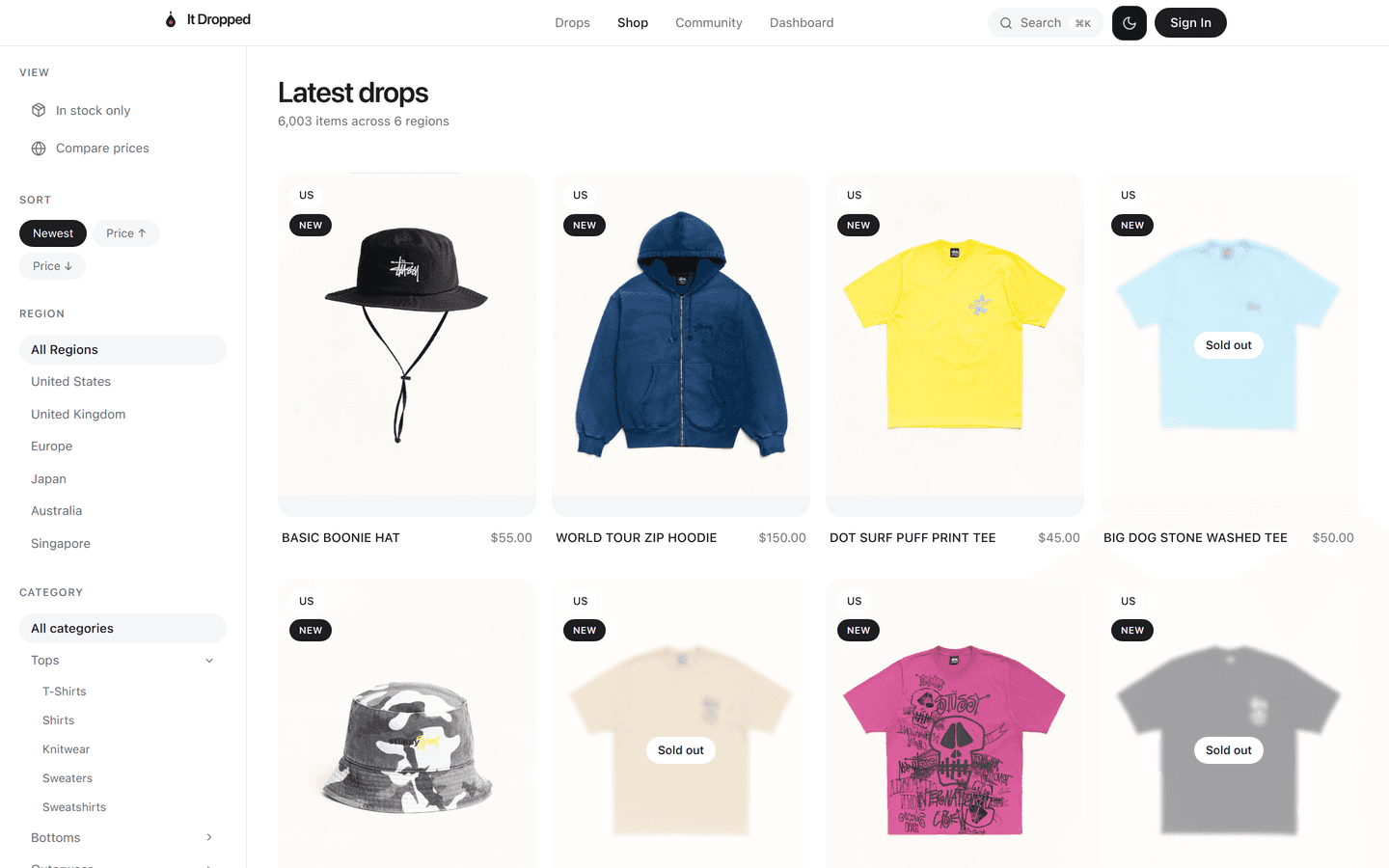
A Stüssy tracker that compares six storefronts, follows new drops, and works out what a garment costs after shipping and duty.

Solo, live, Jan 20261

It Dropped screenshot

6

storefronts, each in its own currency

15

countries it can price delivery to

25 s

for a full run of about two dozen requests

720 MB

of database traffic a month, where the naive design needed 35 GB

Why

Stüssy sells the same garment through six storefronts, and each prices it independently. A tee is $45 in the US and S$85 in Singapore. Which is cheaper depends on where you live, because shipping and duty are often bigger than the price gap.

The hard part turned out to be knowing that two listings are the same garment at all. The stores do not agree on how to identify a product, and everything else depends on getting that right.

How it works

Two hosted platforms and a scheduled job, with no server to run. A Go scraper reads each store's public catalogue on a schedule and writes only what changed to Postgres. The site reads from there, and the delivered cost for your country is worked out in the browser.

Follow a catalogue update

The schedule starts a catalogue refresh.

daily, Fridayspage by pagecatalogueratesonly what changedreadsScheduleGitHub ActionsSix storefrontsFive Stüssy regions, DSM SingaporeBrowserScraperGoFetch routeVercel, token-protectedExchange ratesECB reference ratesSite and read APINext.js on VercelPostgresSupabase: search, price history, row-level security

Decisions

Finding the same garment in six stores

Joining on a product's URL name matched about 4% of Australian products to their US twins, and Singapore's retailer codes matched none of 250. What works is the style code: the leading part of the SKU, or for Singapore, recovered from the URL.

Only read what changed

Each run reads one fingerprint per product and fetches full rows only where it differs. Reading everything every five minutes would have used about 35 GB a month of a 5 GB allowance. Daily, with fingerprints, uses about 720 MB.

Fetch through Vercel, do the rest in CI

The stores answer a GitHub Actions runner with “too many requests” on the very first request, and no amount of waiting fixes that. A token-protected route on Vercel fetches the page instead; the same stores answer it in about 130 ms.

An unattended job must fail loudly

The catalogue once sat frozen for six months because every write raised the same error while the run reported success. Now any failed store, empty result or failed write ends the run with an error, and a partial fetch never marks products as gone.

Delete the API server

Thirteen read-only routes did not justify a second service to run. The queries moved into SQL functions and a view, and the Go API was deleted rather than left to rot.

A schedule taken from the data

Of 500 products sampled, 322 were published on a Friday, 315 of them at exactly 10:00 UTC. So the scraper runs daily, plus three times just after that hour on Fridays.

Built with

Scraper
  • Go
  • GitHub Actions
Storage
  • PostgreSQL
  • Supabase
Search & access
  • Full-text search
  • Row-level security
Frontend
  • Next.js
  • React
  • TypeScript
  • Tailwind CSS
Accounts
  • Supabase Auth
  • Google sign-in
Alerts
  • Supabase Realtime
  • Telegram Bot API